Systems Disagree on the Same Customer, Project or Device
Data is scattered across CRM, ERP, projects, assets, and IoT systems, preventing AI from gaining a complete and trusted business context.
Connect existing ERP, CRM, OA, finance, and IoT systems to unify data, enterprise knowledge bases, RAG, models, agents, and AI workflows.The platform is deeply integrated with the business system, introducing AI analysis, judgment, dispatch, early warning, and collaboration capabilities in business processing.
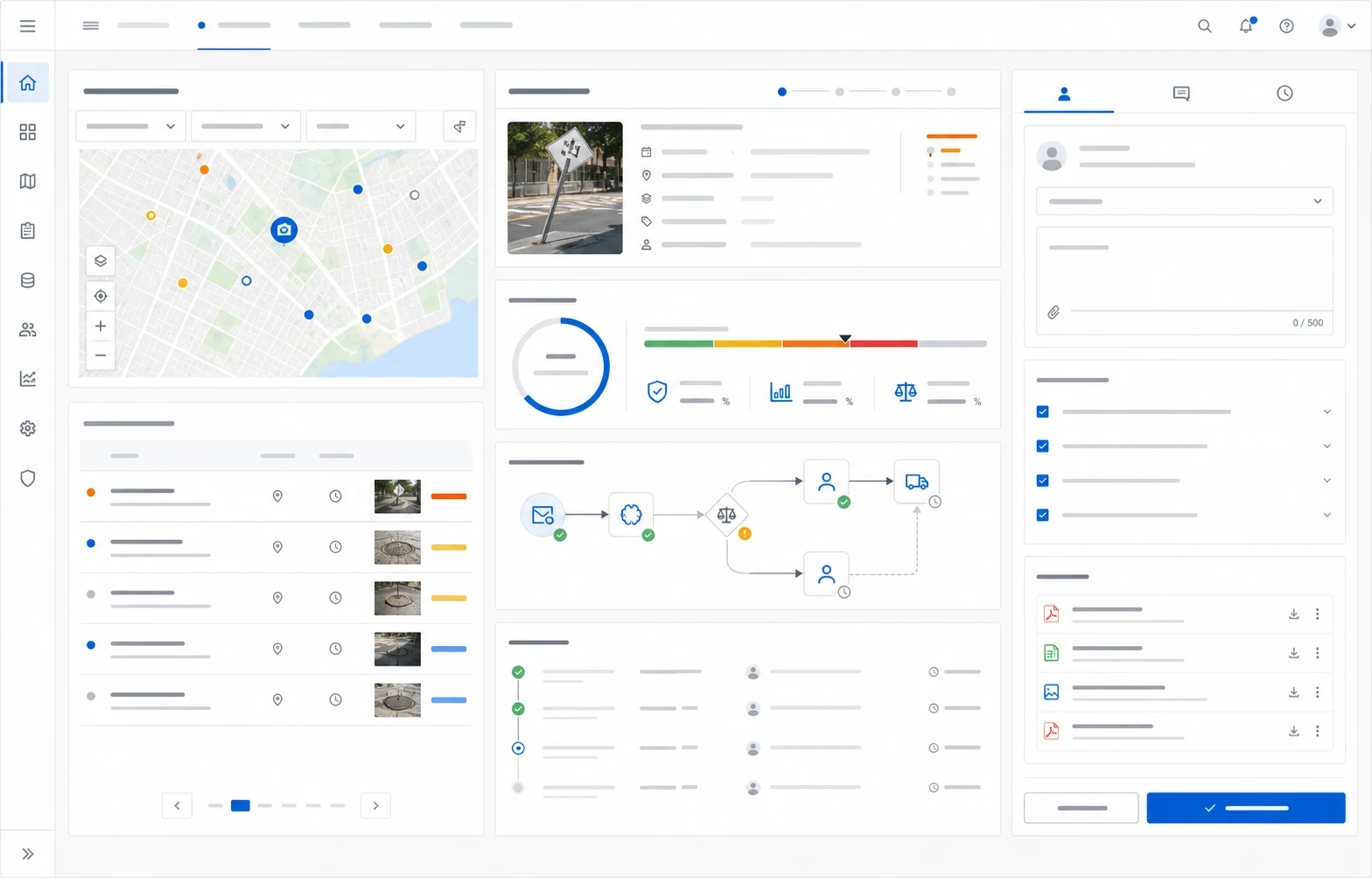
Enterprise AI does more than add another chat interface. It works with existing data and rules to trigger tasks, dispatch work, initiate approvals and alerts, and securely return results to business systems.
Data is scattered across CRM, ERP, projects, assets, and IoT systems, preventing AI from gaining a complete and trusted business context.
Contracts, systems, cases, and service standards are difficult to retrieve, reference, and trace, and organizational experience cannot be reliably reused.
Without tool calls, workflows, and human confirmation, the agent stays in the dialogue layer and cannot complete the closed loop of cross-system business.
Connectors, models, knowledge bases, and governance capabilities are being built repeatedly, at increasing cost, and difficult to replicate in more organizations.
Instead of replacing ERP, CRM, OA, or industry systems, Youma Enterprise AI & Data Platform connect data, knowledge, and events on top of them, allowing agents to invoke tools, trigger processes, and send results back to the systems employees are using.
The platform uniformly provides Data Transmission Service, Knowledge Base and RAG, Model Service, Agent, AI Workflow, AIoT Events, Permissions, and Audit Capabilities.
Management sees operations through the cockpit, business personnel collaborate through AI assistants, and digital employees perform tasks according to rules. Youke Cloud, Urban Asset Operations, and Project Operations share the same set of capabilities, system connectivity, infrastructure, and security governance.
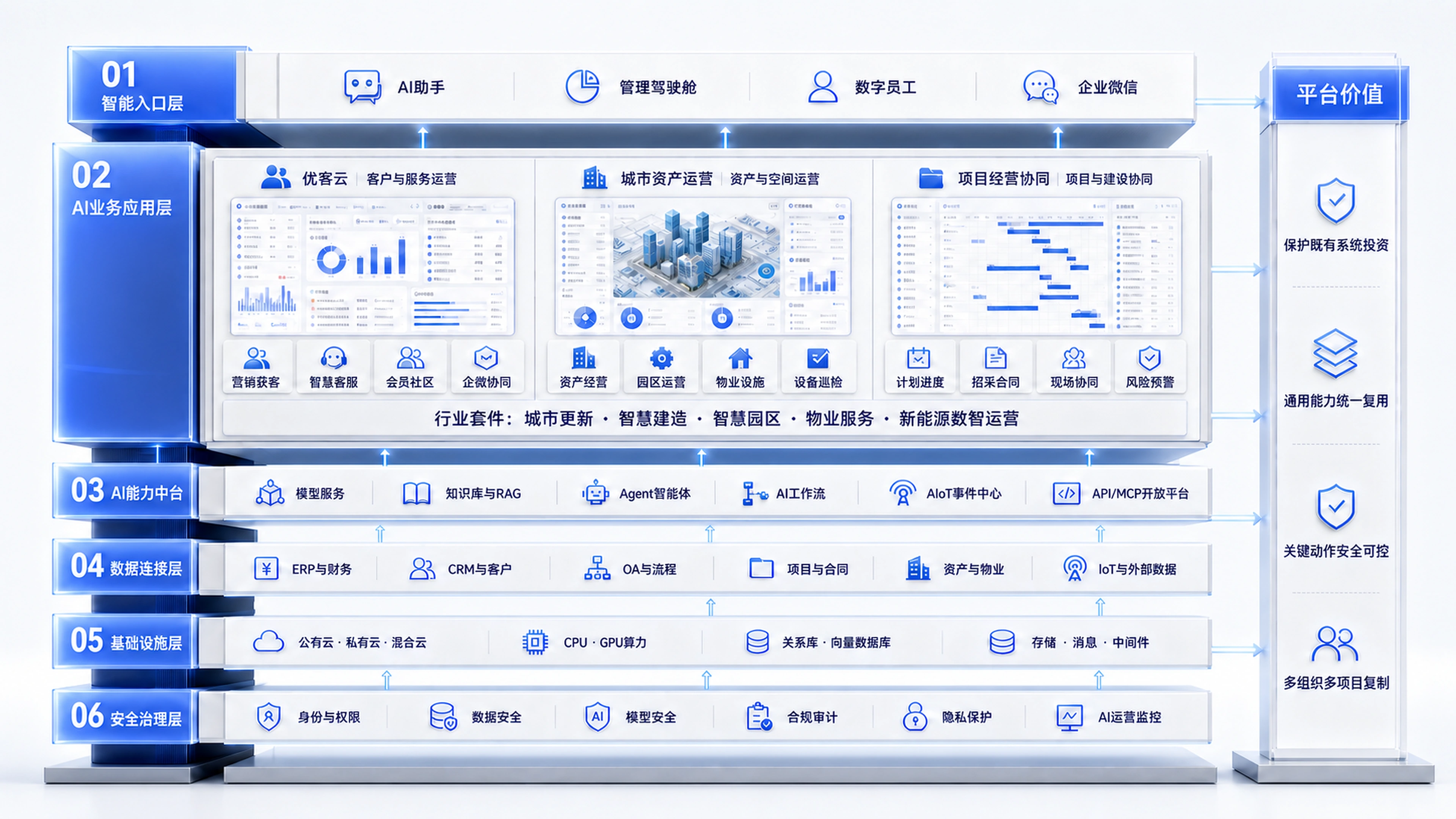
AI assistants, management cockpits, digital workers, and WeCom handle different usage modes, with applications organized by three product lines and industry suites.
Models, knowledge bases are reused on demand with RAG, Agent, workflow, AIoT, API/MCP, and business system connectivity.
Public cloud, private cloud, hybrid cloud and computing power data foundation are adapted on demand, and identity, data, model, privacy and audit are integrated throughout the process.
Systems, databases, messages, and devices
Master data, quality, and permissions boundaries
Knowledge Base, RAG and Semantic Relation
Models, agents, tools, and rules
Tasks, dispatches, alerts and write-backs
Evaluation, audit, and multi-project replication
Data integration, enterprise knowledge bases and RAG, agents, AI workflows, and the AIoT event center work together as executable, verifiable processes that can write results back to business systems.
After the customer message is entered, the AI recognizes the intention, combines customer records and enterprise knowledge to generate a reply or pre-work order; complex issues are confirmed by the customer service, and then written back to the CRM or work order system.
Processing link: identify the request → retrieve the basis → generate a reply/pre-work order → manual confirmation → write back to the systemAfter the equipment or energy consumption alarm is triggered, the AI correlates the equipment file, historical work order, and operation and maintenance standards to determine the risk level and initiate inspections, dispatches, or upgrades.
Processing link: receive alarms → associate files → judge risks → trigger inspections/dispatch ordersWhen contract terms or project plans change, AI compares key terms, schedules, and tasks, forms a risk list, and alerts responsible parties to address them.
Processing link: read changes → compare terms and progress → output risks → alert and write back tasksManagers pose business problems, AI takes numbers across systems and explains anomalies, generates evidence-based analysis conclusions, and converts improvements into tracking tasks.
Processing link: ask questions → aggregated data → interpret exceptions → generate reports/tasksThe platform uniformly manages permissions, models, prompt words, tools, costs and logs. High-risk actions must be confirmed manually, and the call basis and results must be written back to the end-to-end.
Governance Link: Identity Permissions → Model and Tool Control → Manual Validation → Log Audit → Continuous EvaluationThe platform unifies business objects shared across product lines, allowing agents to understand the relationship between the same customer, project, asset, or contract in different systems, while maintaining the data responsibility of the original system.
The shared foundation provides data, knowledge, models, agents, workflows, and governance. Each product line retains ownership of its end-to-end business process, product boundaries, and commercial scope.
Invoke customer, knowledge, intelligent reply, request recognition, pre-work order, membership and messaging capabilities to serve customer growth, delivery, customer service, membership and User Operations.
Representative AI scenario: WeCom reply, customer service knowledge, request recognition, customer insightView Youke CloudCall on asset space master data, AIoT events, work order identification, inspection and early warning, and business analysis capabilities to serve parks, buildings, properties, and urban assets.
Representative AI scenarios: equipment early warning, work order dispatch, asset operation diagnosis, inspection analysisView Urban Asset OperationsCall projects, suppliers, contracts, plans, tasks and knowledge capabilities, service project approval, procurement, contracts, execution, acceptance, settlement and review.
Representative AI scenarios: contract review, plan early warning, task supervision, project operation analysisView Project OperationsDevelopment & Construction, Smart Construction, Smart Park, Property Services, Urban Renewal & Asset Operations, New Energy Digital Operations and other industry suites combine three product lines and platform capabilities according to customer problems, and no longer rebuild a set of AI bases for each project.
The first phase starts with scenarios where input is clear, accountability is clear, existing data is available, and results are measurable; system connectivity, manual validation, result write-back, and acceptance metrics are clarified before launch.
Identify business issues, existing processes, system boundaries, data conditions, responsibilities, and current metrics.
Select one or two high-value closed loop scenarios with clear input, clear responsibilities, and measurable results.
Connect data, knowledge, events, and business actions on demand, without the need to migrate the entire system at once.
Verify data quality, answer basis, task execution, manual review, result write-back, and security perimeter.
Encapsulate mature capabilities as templates and replicate them across more scenarios, organizations, projects, and product lines.
Continuous evaluation and iteration based on calls, cost, accuracy, closed loop results, and business feedback.
The enterprise AI employee workbench places knowledge Q&A, data analytics, agents, app stores, and task centers in a unified portal, and records calls, human confirmations, and results written back.
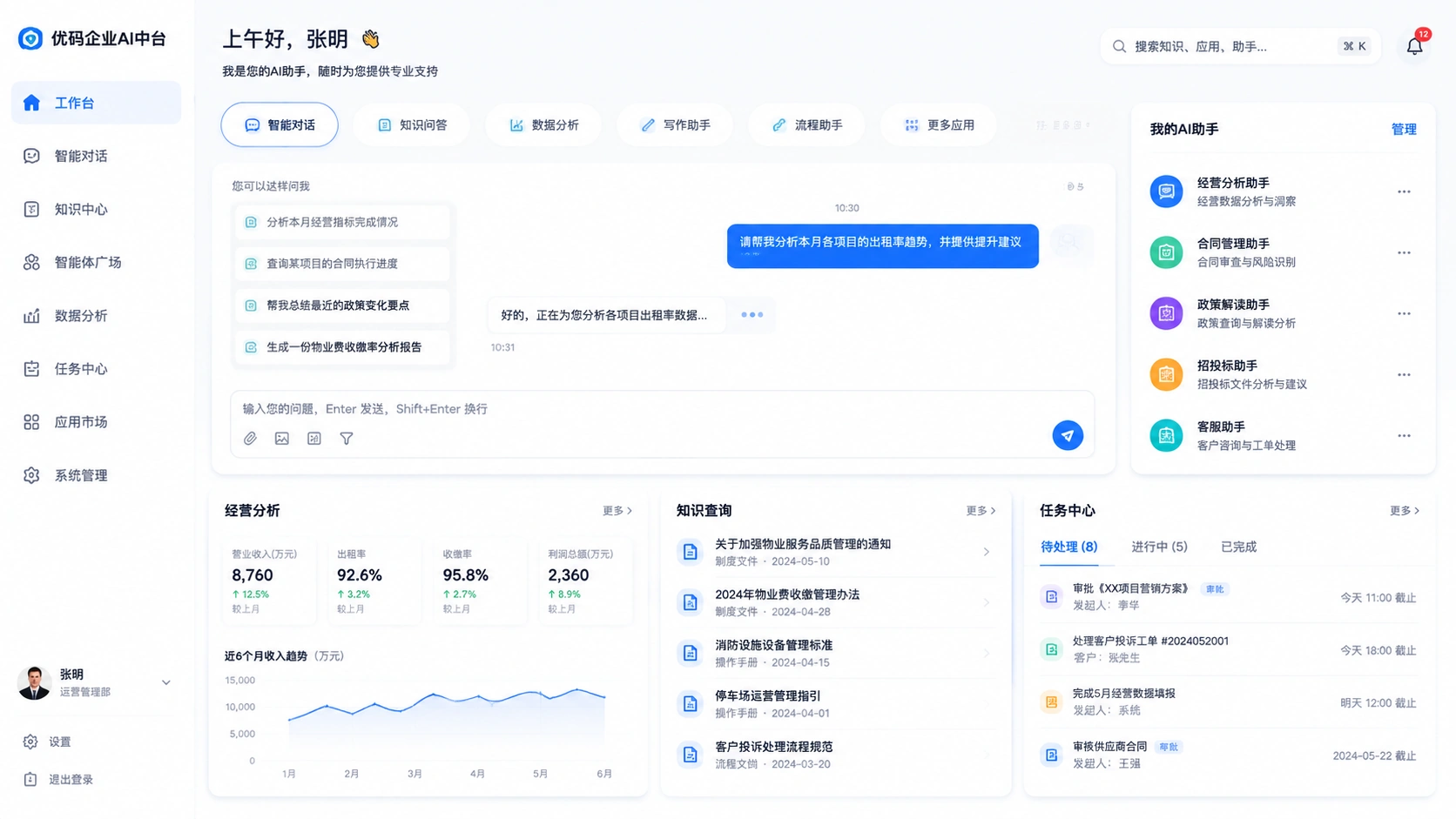
Employees can call agents such as business analysis, contract review, fault judgment, and customer service processing from business issues; process actions, manual review, and execution results are unified into the task center.
View Customer StoriesFrom knowledge retrieval and data access to tool calls and result write-backs, the platform uniformly controls permissions and keeps records; key decisions are confirmed by people, and problems can be traced back to the basis and chain of responsibility.
Inherit organization, roles, and data scope to control knowledge retrieval, tool calls, and result visibility.
Unified Model Routing, Version, Tip Words, Tools, Cost, Evaluation, and Deactivation Mechanisms.
Key decisions are retained for manual review, recording basis, action, approval, write-back, and chain of responsibility.
Support for privatization, innovation, open interfaces, low-code expansion, and adaptation to existing infrastructure.
Focusing on existing system integration, data and knowledge security, agent implementation, and the first phase of the scenario, the product capabilities, system responsibilities, and application methods of the enterprise AI platform are explained.
No. The platform connects to existing systems through APIs, databases, messaging, files and events, then adds knowledge, analysis, decision support, workflows and collaboration. Existing systems keep their current responsibilities, and each system can continue to evolve independently.
No. Each scenario can use the appropriate mix of API calls, data services, event subscriptions, indexing and data governance. The architecture defines whether data is copied, where it is stored, how often it is updated and which system owns each responsibility.
Knowledge content is managed by source, version, permissions, and valid period; responses can be cited and the scope of retrieval can be limited in combination with role permissions. High-risk scenarios can require manual review before entering business actions.
The platform combines models with enterprise knowledge, business objects, tools, rules, and workflows, allowing agents to create tasks, initiate approvals, generate pre-orders, trigger dispatches, or write back results, with human validation at key nodes.
Yes. Deployment can be designed around enterprise security, data boundaries, infrastructure and Xinchuang requirements. The model, database, middleware and integration scope are confirmed during technical discovery.
Start with a scenario that has clear inputs and ownership, usable data, a complete workflow and measurable results, such as drafting customer-service work orders, classifying and dispatching work orders, reviewing contracts or alerting equipment risks.
Combining your existing systems, data conditions, business processes, and goals, we will provide recommendations for connection methods, initial scenarios, manual verification points, and phase acceptance.