Executable Plans
Targets are divided into nodes, responsibilities, and outcomes, and progress goes beyond reporting percentages.
Project objectives, procurement matters, contract performance, project acceptance, material batches, and personnel teams are continuously advanced using unified project data. Management keeps track of schedule deviations, responsibility status, and risks in a timely manner, and business teams work together to achieve the same goals.
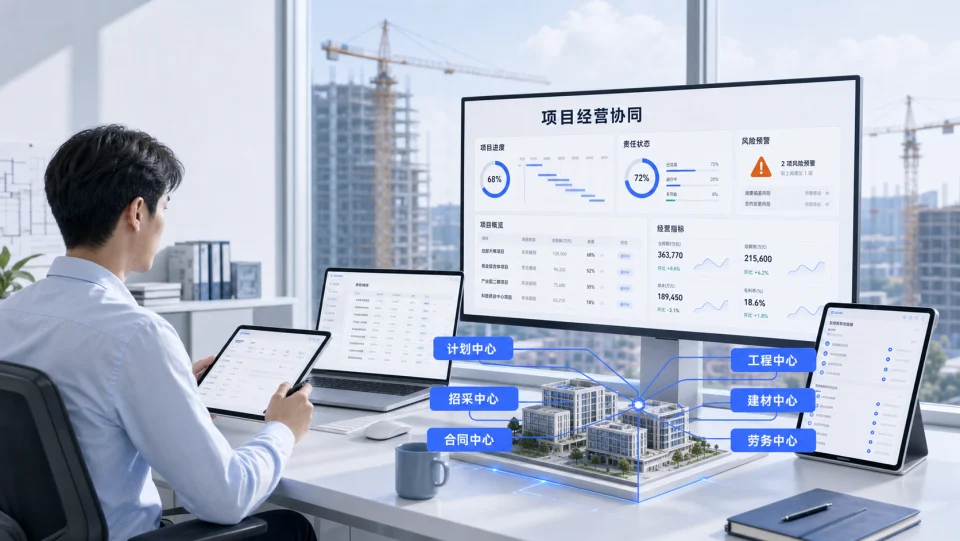
Project objectives, procurement items, contracts, project acceptance, material batches, and personnel teams are all related. Managers can trace project deviations directly to planning nodes, business documents, field records, and responsible persons.
Targets are divided into nodes, responsibilities, and outcomes, and progress goes beyond reporting percentages.
A continuous record is formed of supplier admission, bid submission, evaluation and award, and process documentation.
Budget, template, performance, acceptance and payment are checked against each other on the main line of the contract.
Quality and safety, engineering acceptance, material batches, personnel attendance and payroll are all based on the process.
Enterprises already have OA, finance, tendering or on-site systems, and when cross-system collaboration still relies on manual urging, table aggregation and meeting alignment, it is necessary to establish a project collaboration main line that connects management and on-site.
Group, regional, and project maintenance plans, node adjustments cannot simultaneously affect procurement, contracts, and performance arrangements.
Procurement items, tender progress, bid results and contract terms are repeatedly entered, and signing and payment risks are discovered too late.
Quality and safety, project acceptance, and on-site progress are scattered in forms and group chats, unable to continuously support performance judgments.
There is a set of ledgers for entry materials, inventory whereabouts, on-site personnel, and attendance wages, and the true status of the project is difficult to verify.
Management uniformly reviews plan deviations, procurement progress, contract performance and on-site risks, and drills down to relevant business objects, responsible persons and processing status.

Clarify the division of responsibilities, collaboration lines, and shared business objects of the six professional centers.
Swipe horizontally to view the complete business blueprint
Goal achievement · Plan deviation · Procurement progress · Contract execution · Quality and safety · Material usage · On-site employment
Planning Center · Procurement Center · Contract Center · Engineering Center · Building Materials Center · Labor Center
Operation control: planning → procurement → contract → payment and settlement; on-site construction: collaborative execution of project quality and safety/building materials/labor services
Organization, Project, Planning Node, Supplier, Contract, Building Process, Material Batch, Personnel Team, Acceptance Results
Enterprise AI · Data Governance · Process · Permissions · Message · Audit · Interface · Mobile Collaboration
Unify the preparation standards of projects and key tasks with the enterprise plan template, and distribute the nodes, responsibilities, construction period, pre-post relationships, and results to the executive position; continuously update the status through process reporting, business result write-back, early warning, and supervision.
The plan connects goals, responsibilities, business results, and reviews into a continuously updated execution thread.
Focusing on node progress, responsibility status and risk early warning.
Plan achievement rate · Milestone deviation · Responsibility status · Early warning supervision · Template reuse
Manage supplier access, procurement plan, sourcing, bid issuance, bid submission, review, award decision and archiving around project procurement matters. The procurement progress is kept corresponding to the project nodes, and the award results are used as the upstream business basis of Contract Center.
Procurement Center answers how to recruit, how to evaluate, and how to decide; contract signing, performance, payment, and settlement are undertaken by Contract Center.
Focus on purchasing plans, suppliers, tender progress and award decision status.
Qualified suppliers · procurement progress · invited tenders · award results · compliance risk
Focusing on expenditure contracts, taking into account income contracts, connecting procurement, budget pre-control, template drafting, approval and signing, construction period output value, visa change, acceptance reconciliation, receipt and payment and settlement closing.
The contract has a budget, the text has a version, the performance has a record, and the payment has a basis.
Concentrate on checking budget occupancy, contracted version, performance progress and payment basis.
Budget occupation · Contract version · Performance change · Acceptance reconciliation · Payment settlement · Risk early warning
Around the construction site of the project, the quality and safety standards, inspection tasks, problem rectification, engineering acceptance, actual measurement, sample first and technical disclosure are connected into an executable, reproducible and traceable engineering management chain.
Unified management of quality, safety, project acceptance, prototypes and knowledge, planning nodes and contract performance results are coordinated by project.
Focus on tracking quality and safety, rectification and reinspection and project acceptance.
Problem ledger · rectification timeliness · acceptance records · measured analysis · sample standard · quality and safety files
Focusing on the quantity, price, goods, market, and account of project materials, it connects budget general control, procurement plan, supplier order placement, distribution tracking, entry acceptance, inventory ledger, and settlement evidence.
Material budgets, orders, distribution, acceptance, inventory, and batch settlements are continuously tracked along the same on-site execution chain.
Focusing on material planning, distribution, on-site acceptance, inventory and batch traceability.
Volume and price deviation · Order delivery · Acceptance batch · Weighing counting · Inventory whereabouts · Settlement basis
Focusing on the real names, contracts, education, entry and exit, team, attendance, transfer, and salary of project personnel, a traceable employment chain is established to determine who is on site, who is working for whom, how much attendance, how much to pay, and whether it has been issued.
Verified identities, team responsibilities, site tasks, attendance, payroll, and payment receipts remain connected for each project.
Concentrate on real-name access, team attendance, payroll accounting and payment status.
Real-name ledger · Access status · Abnormal attendance · Payroll · Issuance receipt · Employment compliance file
After the planning node is adjusted, procurement, contracts and on-site tasks are updated simultaneously; project acceptance, material entry and labor performance results are returned in a timely manner, directly supporting risk early warning, payment settlement and business review. Management can see the progress deviation, responsibility and processing status at any time.

Planning, procurement, contracts, engineering, building materials and labor are continuously coordinated around the same project.
Swipe horizontally to view the full collaborative journey
Forming plans, nodes, responsibilities, and outcomes
Complete sourcing, bidding, evaluation and award
Complete budget verification, signing and registration
Execute quality and safety, rectification and reinspection and engineering acceptance
Connect distribution, acceptance, inventory and batch traceability
Verification of real-name access, team attendance and salary payment
Support fulfillment, payment, and calibration for the next cycle with field results
Which project objectives deviate, and where are the contractual and financial risks?
Why is the node delayed, who needs to deal with it, and what will be affected later?
What step is the current business in, and whether the upstream and downstream bases are complete?
What to accomplish today, how to report it, and who to hand over the problem to
Which system is responsible, how data is synchronized, and how permissions are audited
City Investment Park, Development & Construction, Urban Renewal, Manufacturing Energy Technology Renovation, and Property Facility Renovation can manage planning, procurement, contracts, engineering, materials, and employment according to their respective business priorities.
Annual operating objectives are divided into renovation, construction, and operation projects, and procurement, contracts, and payments are advanced by node.
The main plan is connected with procurement award decision, contract signing, construction period, output value, change, acceptance and settlement.
The asset renewal task enters the project plan, and the acceptance and handover results are returned to the asset operation after completion.
Equipment procurement, construction contracts, arrival inspection, and payment are organized around the same technical transformation project.
The annual key work, maintenance and transformation, suppliers, service contracts and acceptance evaluation form a closed loop.
Focusing on the product division, cross-business collaboration, system integration and implementation methods of the six professional centers, the key issues are clarified.
It connects project objectives, procurement matters, contract performance, and on-site execution through Planning Center, Procurement Center, Contract Center, Engineering Center, Building Materials Center, and Labor Center, ensuring that progress, responsibilities, and risks are continuously traceable.
Planning Center manages targets and plan execution; Procurement Center manages suppliers and tendering; Contract Center manages signing, performance, payment and settlement; Engineering Center manages quality, safety, acceptance, samples and knowledge; Building Materials Center manages material controls, delivery, acceptance and traceability; and Labor Center manages verified identities, contracts, safety training, attendance and payroll.
Select one or more centers around business priorities, beginning with a clear, testable end-to-end workflow and expanding by project and organization. The first-phase scope is based on business ownership, existing systems, data readiness, and acceptance goals.
Planning Center manages the main line of the project, answering when the project is completed; Procurement Center undertakes the execution of special projects for procurement, answering how to source, tendering, review and evaluate and award each bid.
Procurement Center is responsible for sourcing, inviting tenders, evaluation and award; Building Materials Center is responsible for total material control, order distribution, entry acceptance, inventory and batch traceability; Contract Center is responsible for contract terms, performance, payment and settlement. Purchase plans, orders, acceptance results and settlement basis are the main synergistic boundaries.
Engineering Center is responsible for on-site professional acceptance of processes, quality, safety, and measured quantities; Contract Center uses confirmed performance or acceptance results as the basis for payment, settlement, and risk judgment, and does not repeat the professional process of construction sites.
The existing system can continue to handle general processes, financial accounting, fund payment, and professional operations, and Project Operations connects objects, tasks, results, and status according to the scope of confirmation.
The platform is designed for urban investment and park operators, development and construction organizations, engineering projects and multi-project groups. It also supports project-based work such as manufacturing or energy upgrades and property-facility renovation.
Prepare a project, current plan, result of a purchase or bid, a contract, and a class of site materials in quality and safety, materials or labor. See on-site how progress is updated, how responsibilities are tracked, how risks are alerted, and how business results support performance and settlement.